

Most British houses were built long before anyone thought seriously about insulation, and dogs feel that a lot sooner than we do. Tile in the kitchen, laminate in the hallway, a letterbox draught that never quite goes away — all of it sits at floor level, exactly where your dog spends most of their day. A cosy-looking bed from a marketplace listing doesn’t automatically fix any of that. Here’s what actually keeps a dog warm, what’s worth paying for, and where a proper warm dog bed UK actually earns its price.
“Cosy” on the Listing Doesn’t Always Mean Warm
Search “warm dog bed uk” and most of what comes back just looks warm — soft fabric, autumnal product photos, occasionally a dog wrapped in a tartan blanket for the thumbnail. Photos aside, three different things get lumped under “warm,” and they’re not interchangeable:
Self-warming beds use a dense faux fur or thermal-reflective lining that reflects a dog’s own body heat back at them rather than letting it escape into the floor. No batteries, no wiring — the materials do the work on their own.
Insulated usually describes the base rather than the top layer: a raised, padded rim or a thicker filled underside between your dog and a cold tiled or laminate floor. This matters more than people expect, since a lot of heat loss happens straight down into the floor, not sideways into the room.
Just soft is the one to watch for. A thin layer of fluffy fabric over minimal filling looks warm in a photo and feels warm for the first ten minutes, then compresses flat and stops doing much of anything.Pin
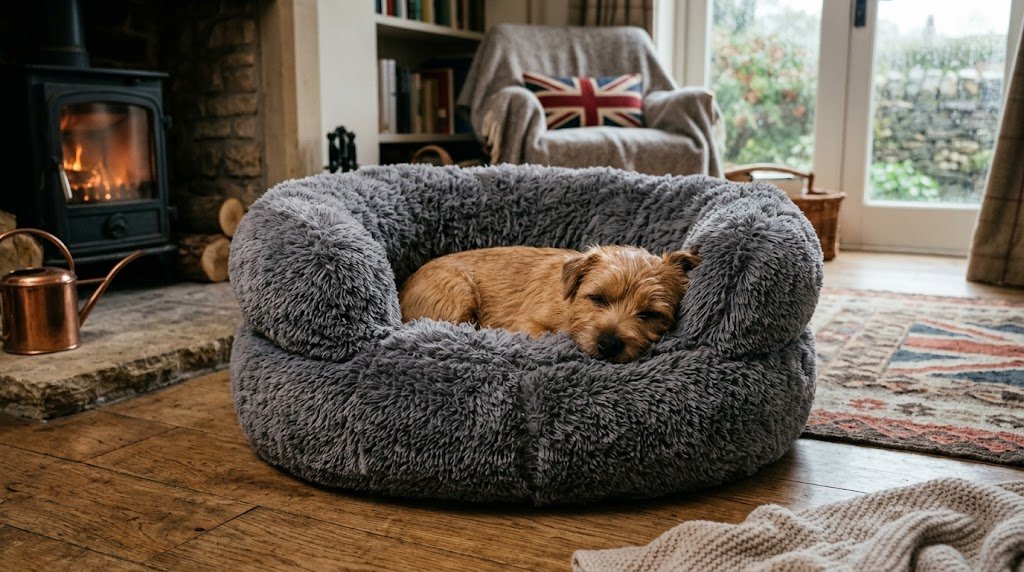
None of this is a scam exactly — they’re just different products wearing the same word. Worth knowing which one you’re actually buying before you order.
🛏️ Donut Dog Bed, Fluffy Plush Round Cat Bed — £26.99–£45.99 · Self-warming faux fur top, 20cm raised rim, 6 sizes, 11 colours
Which Dogs Actually Feel the Cold
Not every dog needs a heavily insulated bed, but some genuinely do:
- Short or thin-coated breeds — Whippets, Greyhounds, French Bulldogs, Chihuahuas and similar breeds have very little natural insulation and lose heat fast
- Senior dogs — circulation slows with age, and cold tends to make stiff joints and arthritis noticeably worse overnight
- Puppies — can’t regulate their own body temperature well in the first few months
- Dogs sleeping on tile, laminate or concrete — kitchens, conservatories, utility rooms
- Anywhere draughty — near a back door, a letterbox, or in an older UK house with single glazing
- Toy and small breeds — a higher surface-area-to-body-mass ratio means they lose heat faster than larger dogs
If none of that applies — a young, well-coated dog sleeping on carpet in a warm room — a heavily insulated bed is a nice-to-have rather than a necessity.
What to Actually Look For
- A raised rim or bolster edge — blocks draughts at floor level and gives your dog something to burrow against
- A dense, filled base — not just a thin cushion. Filling that keeps its shape (like PP cotton) holds warmth far better than filling that flattens after a few weeks
- Faux fur or plush top fabric — traps a layer of warm air close to the body, unlike thin cotton or polyester that just lies flat against the skin
- A non-slip base — keeps the bed from sliding across tile or laminate, which matters even more in winter when floors get colder and often slightly damp from wet paws
- A washable cover — dogs shed more indoors in winter and track in more mud, so being able to actually clean the bed matters
- The right size to curl into — a warmth-focused bed is usually one your dog can curl up small in rather than stretch flat across. Curling conserves body heat; sprawling loses it
Getting the Size Right
| Bed diameter | Roughly suits |
|---|---|
| 40cm | Small and toy breeds |
| 50–60cm | Medium dogs |
| 70–80cm | Larger dogs (Labradors, Collies) |
| 100cm | Giant breeds (Newfoundlands, Great Danes) |
Measure your dog curled into their usual sleeping position rather than stretched flat — for a warmth-focused bed, snug beats spacious.
Where This Gets Practical
Being straightforward rather than just pointing at the nearest product: our Donut Dog Bed is built around exactly the combination above — a self-warming faux fur top, a 20cm raised rim that blocks draughts and gives dogs something to nest into, and a filled base that doesn’t flatten out after a few washes. It comes in six sizes and eleven colours, so sizing it properly to your dog is straightforward rather than a guess.
If your dog is more of a den animal — the type who’d rather burrow fully out of sight than curl up in the open — it’s worth a look at our CozyPaws Husky Cave Pet Bed instead.
🛏️ CozyPaws Husky Cave Pet Bed — £29.99–£35.99 · Enclosed hood design, extra-soft plush, suited to small dogs
An enclosed hood traps warmth on all sides rather than just underneath, which tends to suit small dogs, cold-sensitive breeds, or anyone who sleeps better tucked away rather than out in the open. Either way, both sit in our full dog bed range if you want to compare sizes and colours side by side.
Keeping Your Dog Warm Beyond the Bed Itself
A good bed does most of the work, but placement matters almost as much:
- Keep it away from external doors, letterboxes and single-glazed windows — draughts travel along the floor before you’d ever feel them standing up
- Add a folded blanket or an old towel underneath on the coldest nights — an extra layer between the bed and a tiled floor makes a noticeable difference
- Resist pushing the bed hard against a radiator. It feels like the obvious fix, but it dries out fabric fast and is a genuine fire risk if anything drapes over the radiator itself
- On really cold nights, a fleece throw over the top of the bed adds warmth without needing a heated pad
- Check the floor itself with a flat hand at dog height before assuming the bed’s the problem — sometimes the floor is the actual issue, not what’s sitting on it
A Few Quick Questions
Do dogs actually get cold indoors in the UK?
Yes, more than most owners assume. Older houses lose heat fast at floor level, and short-coated, senior or very small dogs feel it well before a room feels cold to a standing adult.
What’s the warmest material for a dog bed?
Dense faux fur over a filled, supportive base holds heat best. A thin cushion or flat cotton cover looks fine in a photo but does very little once your dog’s actually lying on it.
Do older dogs need a warmer bed than younger ones?
Generally yes. Poor circulation and stiff joints both get worse in the cold, so a raised, insulated bed genuinely helps rather than just adding comfort.
Can a dog bed be too warm?
Rarely, but it’s worth watching for a dog who keeps moving off the bed at night — usually a sign they’re too hot rather than too cold, especially in a well-heated room.
Is a heated bed better than a well-insulated one?
Not usually necessary for most dogs. A well-insulated, self-warming bed does the job for the vast majority of households without adding a cable near a chewer.
A bed that’s genuinely warm rather than just photographed well is one of the cheaper fixes for a cold house. Have a browse of our full dog and cat range — free UK shipping either way, so trying it out costs you nothing extra to find out.