

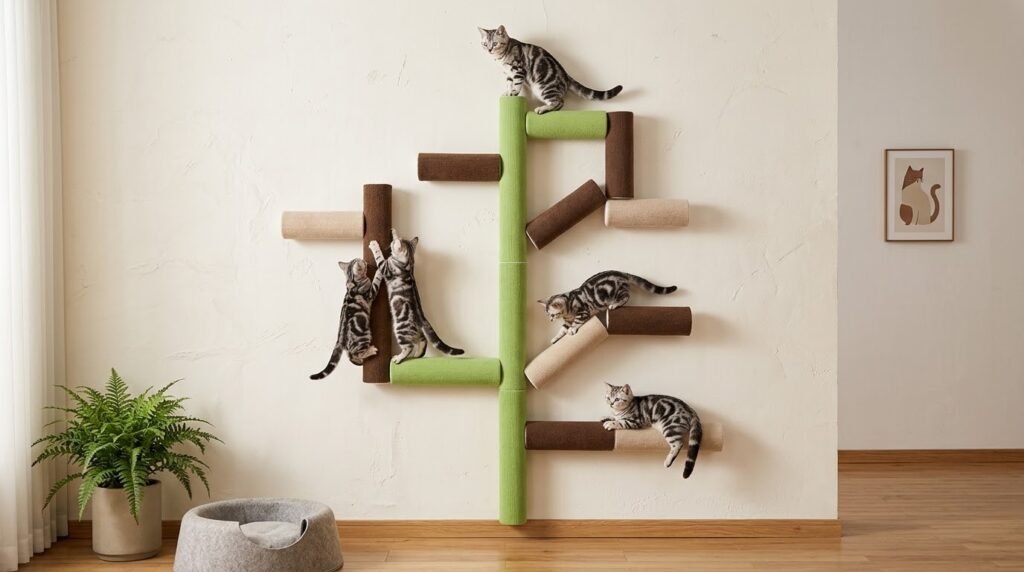
If your cat has ever launched herself onto the top of the wardrobe, taken up permanent residence on the fridge, or turned your bookshelf into a five-tier obstacle course, she isn’t being naughty — she’s telling you she needs a cat climbing tower. Cats have been finding height for thousands of years; your furniture is just the closest thing on offer right now.
We get asked a lot at Mew Vora why a “simple” scratching post costs what it does, or whether a climbing tower is really necessary if a cat already has toys and a comfy bed. It’s a fair question. The honest answer is that vertical space isn’t a luxury item for cats — it’s closer to a basic need, and most indoor cats are quietly missing out on it.
Why a Cat Climbing Tower Matters More Than You’d Think
Every domestic cat carries a bit of their wild ancestry with them, even the ones who’ve never set a paw outside. In the wild, height meant safety. A cat perched above the room could watch for danger, spot prey, and rest without feeling exposed. Indoors, that instinct doesn’t switch off just because the “danger” is now the hoover or next door’s dog barking through the fence.
Vets and feline behaviourists who study this consistently point to the same handful of benefits when cats have proper vertical space:
- Lower stress. An elevated perch gives a cat somewhere to retreat and observe without feeling cornered.
- Fewer multi-cat squabbles. Cats would rather divide a room by height than fight over floor space, so a tower with multiple levels lets two or three cats coexist without the tension.
- Real exercise. Climbing works muscles that flat-floor play simply doesn’t reach, which matters even more for indoor cats who don’t get a garden to patrol.
- Less destructive behaviour. A cat with somewhere appropriate to climb and scratch is far less likely to treat your curtains, sofa arm, or kitchen counter as a substitute.
None of this means every home needs a floor-to-ceiling cat tree. It means most cats are happier with even one dedicated spot that’s theirs to climb, scratch, and watch the world from.Pin
Signs Your Cat Is Asking for More Vertical Space
A few habits are usually a giveaway that your cat’s current setup isn’t cutting it:
- She’s constantly on counters, shelves, or the top of doors, even after being moved along.
- Scratching is happening on furniture rather than anywhere you’ve provided for it.
- In a multi-cat household, there’s more hissing or staring stand-offs than you’d like.
- She seems restless or bored in the evenings, especially in a smaller flat with limited floor space to run around in.
If any of that sounds familiar, it’s not a training problem — it’s an environment gap.
What to Actually Look for in a Cat Climbing Tower
Not all towers are created equal, and in a small UK flat, the wrong one becomes a dust-collecting eyesore fast. Here’s what’s worth checking before you buy:
Footprint over height. A tall tree is impressive in photos, but if it doesn’t fit the corner you have, it won’t get used. A compact, cylinder-style tower often works far better in smaller rooms than a sprawling multi-platform tree.
A genuinely stable base. Wobble is the number one reason cats avoid a climbing structure altogether — one bad scare on a shaky post and they won’t go near it again.
A proper scratching surface built in. Look for sisal rope or a similarly durable wrap rather than carpet offcuts, which shred quickly and don’t satisfy the scratching urge nearly as well.
Materials that hold up. Between claws, shedding, and the occasional hairball, a climbing tower needs to be easy to wipe down and sturdy enough not to sag after a few months.
Somewhere to actually settle. The best designs give a cat a reason to stay, not just climb up and jump straight back down — a lip to perch on, a little platform, or a den to tuck into.
Our Pick for a Cat Climbing Tower: The Mew Vora Climbing Cylinder and Scratcher
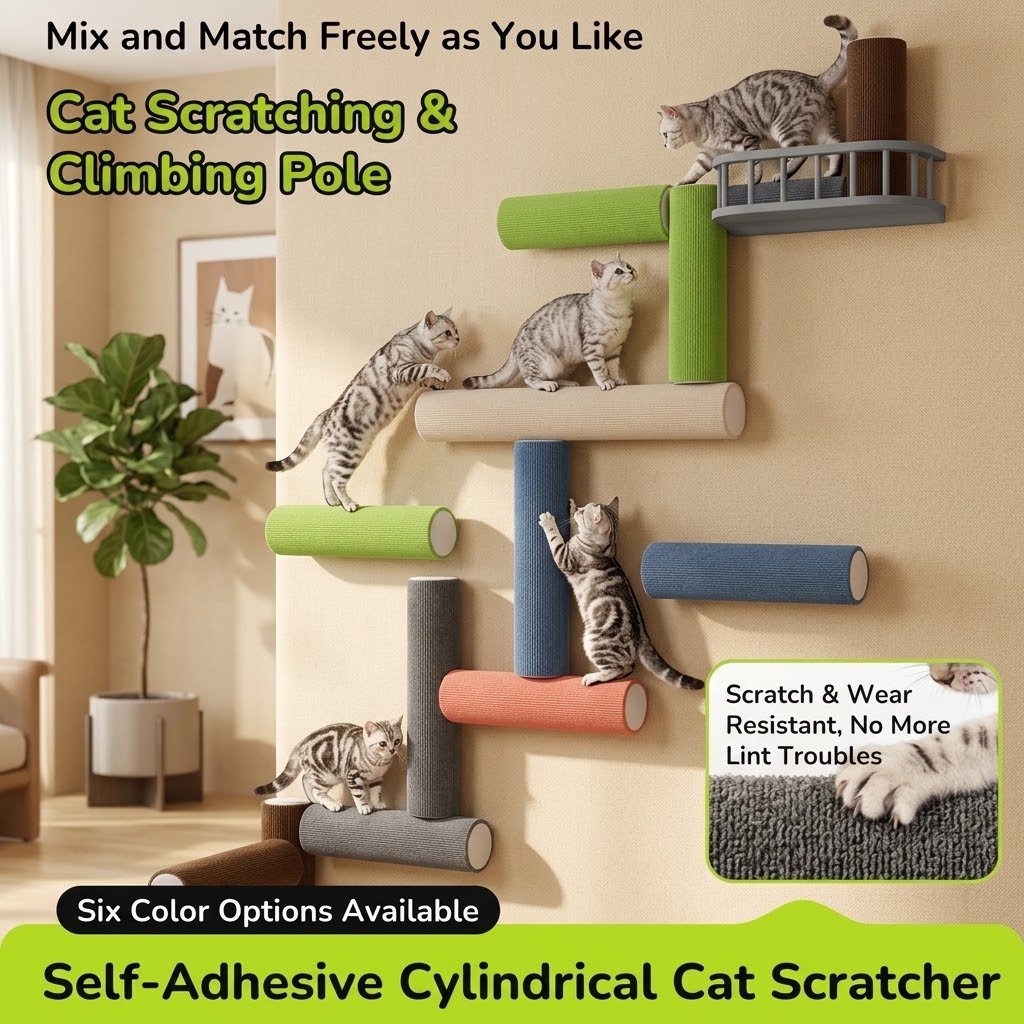
This is exactly the gap our Cat Climbing Cylinder and Scratcher was designed to fill. Instead of a bulky multi-level tree that eats up a corner of the living room, it’s built as a compact cylinder that gives cats a scratching surface and a place to climb and perch without needing a huge footprint — which makes it a genuinely practical vertical cat scratcher for flats and smaller homes, not just houses with a spare room to dedicate to cat furniture.
It comes in a couple of size and colour options (£22.99–£29.99), so it’s easy to match to your space and your cat’s size. If you’ve got a kitten who’s still working out her confidence versus a bigger, more established climber, it’s worth sizing up rather than down.
You’ll find it alongside our other cat products if you want to see the full range.
Building a Complete Vertical Setup
A climbing tower does more when it’s part of a small routine rather than a lone piece of furniture in the corner. A few combinations we’d recommend:
- Pair the climbing cylinder with a den-style resting spot, like our Smart Cat Cave Bed, so there’s a cosy place to land after all that climbing. Cats like having somewhere enclosed to retreat to once the exploring is done.
- Add some motion to keep things interesting. Our Homefish Smart Cat Toy with Motion Sensor gives an extra reason to stay engaged near the tower rather than wandering off to find something to swat on the kitchen counter instead.
- If you’ve got a multi-pet household, a shared resting spot like our Donut Dog Bed, Fluffy Plush Round Cat Bed nearby gives everyone their own ground-level territory too, so the climbing tower doesn’t become the only peaceful spot in the house.
None of this needs to happen at once. Start with the climbing tower, watch how your cat uses it for a week or two, and build outward from there based on what she actually goes for.
Placement and Safety Tips
Where you put a climbing tower matters almost as much as which one you buy:
- Near a window, if you can. Watching the street or garden is enrichment in itself, and it’s usually the first thing that gets a hesitant cat interested in climbing up.
- Away from the busiest walkway. Cats want a vantage point, not a spot in the middle of foot traffic.
- On a level, solid floor. Even the sturdiest base can tip on carpet with a lot of give or an uneven surface.
- Somewhere it won’t get knocked. Give it a bit of clearance from doors and busy corners so it isn’t bumped and associated with a fright.
It’s also worth checking the base and scratching surface every few months, especially with an enthusiastic scratcher. Tightening any loose fixings early keeps the whole thing stable for much longer.
FAQ: Cat Climbing Towers
Do I need a climbing tower if my cat already has a scratching post? A flat scratching post satisfies the scratching instinct, but not the climbing one. A tower does both, which is why cats with only a post often still end up on the furniture — they’re covering the vertical need themselves.
What’s the best cat climbing tower for a small flat? Look for a compact, stable design rather than a tall multi-tier tree. A cylinder-style tower gives you the scratching and perching benefits without needing a spare corner of the room.
Will one climbing tower be enough for two cats? It depends on the cats. Some are happy to share and take turns; others do better with a second, separate vertical spot — even something as simple as a window perch — so there’s less competition over the one good vantage point.
How do I get my cat to actually use a new tower? Placement does most of the work. Put it near a window or a spot she already gravitates to, and consider rubbing a little catnip on the scratching surface for the first week to build the habit.
The Bottom Line
A cat climbing tower isn’t about filling space in your living room — it’s about giving your cat back a piece of instinct that indoor life doesn’t naturally provide. A compact, sturdy option like our Cat Climbing Cylinder and Scratcher is often all it takes to see a noticeably calmer, more settled cat, and a lot less scratching where you don’t want it.
Browse the full range of cat products at Mew Vora, or get in touch via our contact page if you’re not sure which size or setup is right for your home.