

There’s a sound every cat owner learns to dread: the slow, rhythmic shredding coming from the corner of the sofa. By the time you get there, the arm already looks like it lost an argument. The fix isn’t scolding your cat — it’s finding one of the best cat scratchers for the way your cat actually scratches, because most of what gets sold as a “scratcher” ends up ignored within a week, sitting untouched while the furniture keeps taking the hits.
That gap between what people buy and what cats will actually use is the whole problem. Get it right, and the sofa stays intact. Get it wrong, and you’ve got an expensive post gathering dust in the hallway while your cat quietly goes back to the armchair.
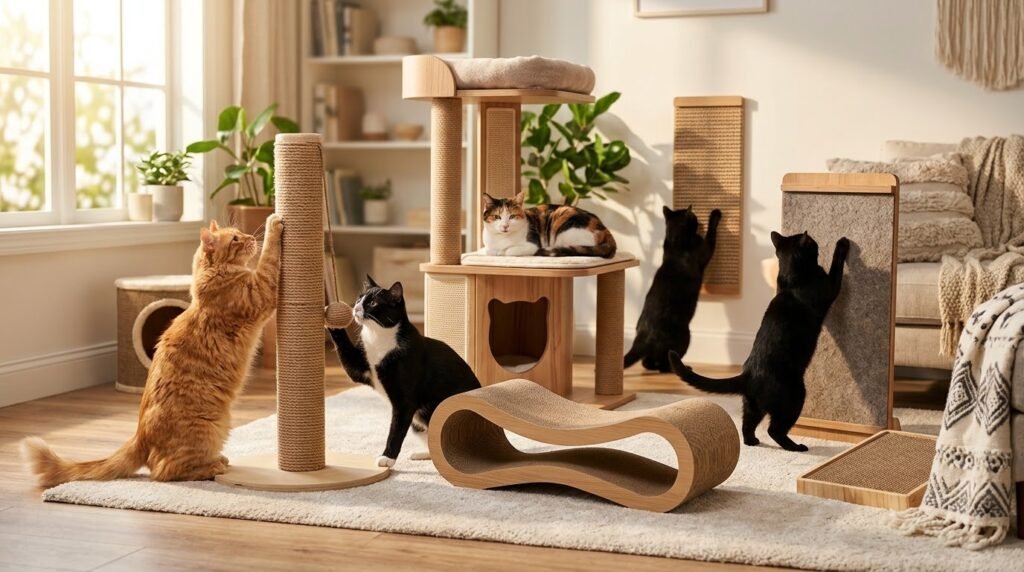
Why Cats Scratch (It’s Not Bad Behaviour)
Scratching isn’t destructive for its own sake. It’s how cats shed the outer layer of their claws, stretch the muscles along their spine and shoulders, and mark territory using scent glands in their paws that we can’t smell but every other cat in the house can. A cat that scratches your sofa isn’t being naughty — it’s doing something it’s biologically wired to do, and it will keep doing it somewhere. The only real choice you have is where.
That reframe matters, because it changes the buying question from “how do I stop this” to “how do I redirect it,” and that’s a much easier problem to solve.Pin
The Mistake That Wastes Most People’s Money on a Scratcher
The most common mistake isn’t picking a bad product — it’s picking the wrong shape for the cat you actually have. Someone buys a tall, elegant sisal post because it looks nice in the living room, and their cat turns out to be a floor-scratcher who wants something horizontal. Someone else buys a flat cardboard pad, and their cat is a full-body stretcher who wants to reach up as high as possible. The scratcher itself might be perfectly good. It’s just aimed at the wrong cat.
A second, quieter mistake: buying a post that’s too short. Most behaviourists agree a scratching post needs to be tall enough for an adult cat to stretch fully upright, front paws extended — in practice, that’s around 80cm (roughly 32 inches) at a minimum. Anything shorter forces a cramped stretch, and cats tend to abandon posts that don’t let them extend properly.
How to Choose the Best Cat Scratcher for Your Cat
A few things matter far more than how the scratcher looks in your living room:
Stability. If a post wobbles or tips when your cat leans into it, they’ll avoid it after the first try — a scratcher needs to feel solid enough to pull against with full body weight.
Material. Sisal rope and sisal fabric hold up best against repeated, aggressive scratching. Cardboard is cheaper and satisfying for cats who like a shredding texture, but it wears out faster and needs replacing every few months.
Height or length. Vertical posts need real height for a full stretch; horizontal scratchers need enough length that a cat isn’t hunched to use them.
Placement potential. Even the best scratcher fails if it ends up shoved in a room your cat rarely visits — more on that below.
Vertical vs Horizontal Cat Scratchers: Which Does Your Cat Actually Prefer?
This is the split that trips up most first-time buyers. Vertical scratchers suit cats that like to stretch upward — you’ll often see this preference in cats that already climb curtains or reach up the corner of a doorframe. Horizontal scratchers suit cats that scratch low, along skirting boards or at the base of furniture.
If you’re not sure which your cat prefers, watch where the current damage is. Scratches high on furniture point to vertical; scratches near the floor point to horizontal. If you genuinely can’t tell, or you’ve got more than one cat, offering one of each removes the guesswork entirely.
Cardboard, Sisal, or Carpet: The Material That Matters Most
Here’s the detail almost nobody mentions, and it’s arguably the single most useful thing in this guide: carpet-covered scratching posts can actively work against you. If the post is wrapped in the same material as your actual carpet or upholstery, your cat has no way to tell the difference between “this is for scratching” and “that armchair is for scratching too.” Sisal rope, sisal fabric, or plain cardboard give a distinct texture that’s clearly not your furniture — which makes the boundary obvious to your cat, not just to you.
Between sisal and cardboard, the real answer is that they serve different cats. A committed, heavy-duty scratcher will out-shred cardboard in weeks and needs the durability of sisal rope. A more occasional scratcher, or a kitten still learning, often does perfectly well with cardboard, and it’s easy to swap out as they wear.
Best Cat Scratchers for Multi-Cat Homes and Large Breeds
Multi-cat households need more than one scratcher, full stop. The commonly cited rule of thumb is one scratching post per cat, plus one extra, spread across the rooms cats actually spend time in — not clustered in a single corner. Cats can be territorial about scratching spots the same way they are about litter trays.
Larger breeds — Maine Coons, Ragdolls, and similarly big cats — need a heavier base and a sturdier build than a standard post. A lightweight scratcher that’s fine for a 4kg cat will tip or slide under a 7-8kg one, and a scratcher that moves is a scratcher that gets abandoned.
Where to Place a Cat Scratcher (Location Matters More Than the Scratcher Itself)
You can buy the single best cat scratcher on the market and still have it ignored if it’s in the wrong spot. Cats tend to scratch when they wake up, when they’re marking a space they use often, or near entry points to the home. Practical placement tips:
- Put the first scratcher near wherever your cat currently scratches instead — right next to the sofa, not across the room from it
- Add one near a favourite sleeping spot, since cats often stretch and scratch right after waking
- Keep at least one in a well-used, visible space rather than tucked away — cats scratch partly to be seen, not just to file their claws
- Move it gradually toward a more convenient spot only after it’s already being used, an inch or two at a time
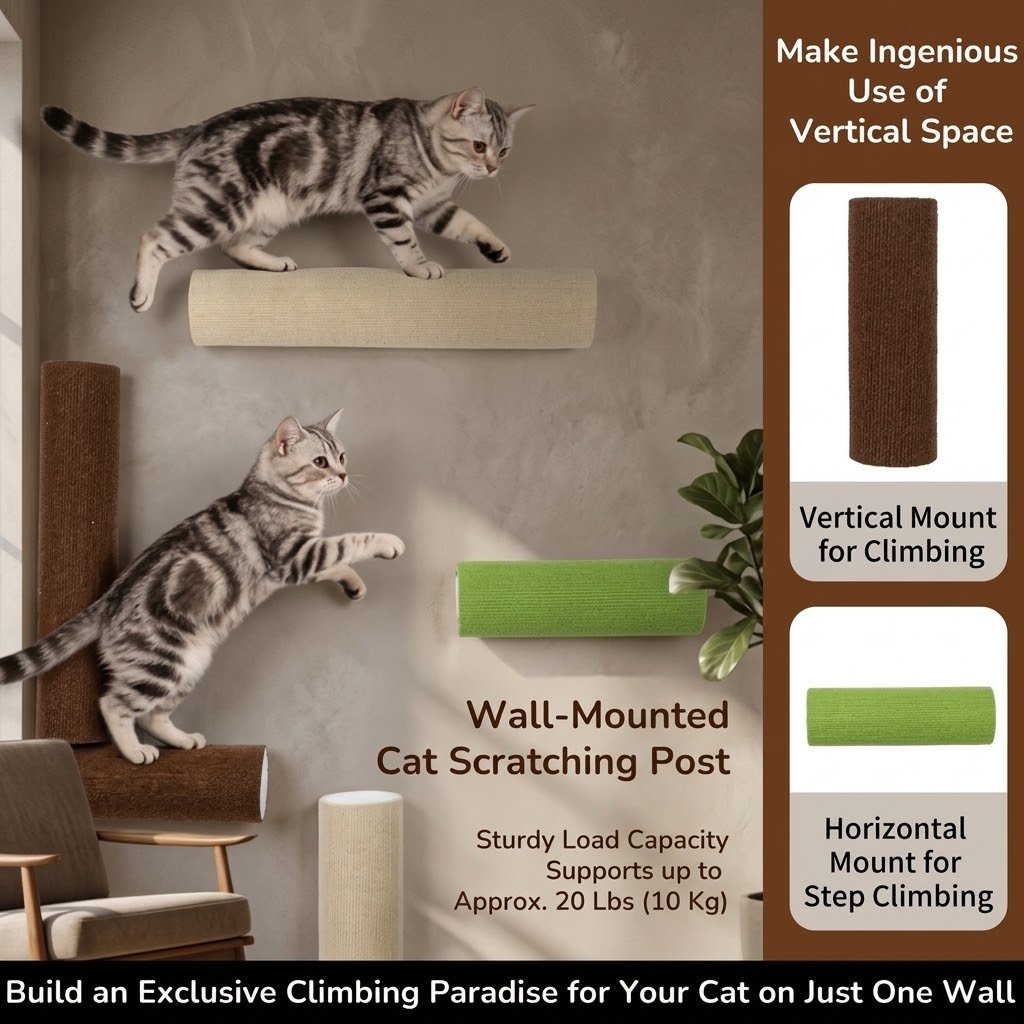
A Scratcher That Solves Two Problems at Once
If you want one product that covers both the climbing instinct and the scratching instinct without buying two separate pieces of furniture, our Cat Climbing Cylinder and Scratcher is built around exactly that gap — a sturdy, sisal-wrapped vertical surface with enough height for a full stretch, on a stable enough base to handle bigger cats. It ships worldwide, so this isn’t a UK-only fix.
Best Cat Scratchers: Quick Answers
How many scratchers does my cat need? At least one per cat, plus one spare, positioned in different rooms rather than side by side.
How long does a sisal scratcher actually last? With regular use, a well-made sisal post typically holds up for a year or more before the rope visibly thins. Cardboard scratchers wear out much faster, often within a few months.
Why won’t my cat use the scratcher I bought? Usually one of three things: wrong orientation (vertical vs horizontal), wrong location, or a base that isn’t stable enough to scratch against confidently.
Can I switch an older cat to a new scratcher? Yes — place the new one directly next to their current scratching spot (even if that’s the sofa) rather than somewhere new, and let them find it on their own terms rather than moving them to it.
Getting the scratcher right isn’t really about the product — it’s about matching it to the cat you actually have. Watch how your cat already scratches, choose the shape and material that fits that habit, and put it where they’ll actually use it. Do that, and the sofa gets to stay in one piece.