

The dog bounds in, tail wagging, straight toward the cat. The cat arches, hisses, and bolts for the top of the wardrobe. Ten minutes later everyone’s stressed, the cat won’t come down for dinner, and you’re wondering if these two animals will ever share a room peacefully. This is what happens when introducing cat to dog gets treated as a single event instead of a process — and it’s the single most common mistake new multi-pet households make.
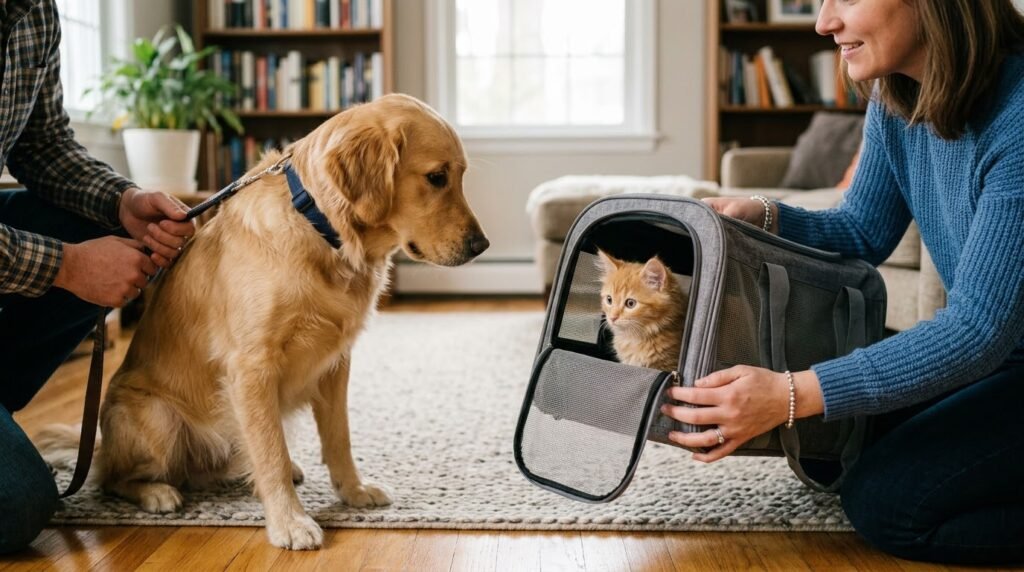
A bad first meeting doesn’t just cause a bad afternoon — it can set the tone for the relationship for months. A cat that’s frightened early on tends to stay defensive around that dog long after the dog itself has calmed down, simply because the first impression stuck. Getting the early stages right when introducing cat to dog is what makes the difference between two pets who eventually coexist comfortably and two pets who tolerate each other at best.Pin
How to Prepare Before You Start Introducing Cat to Dog
- Keep them fully separated at first — different rooms, with a closed door between them, for at least the first few days
- Swap scents before any visual contact — a blanket or towel from one pet’s space placed near the other lets them get used to each other’s smell without the pressure of a face-to-face meeting
- Give your cat vertical escape routes in shared spaces before the dog is ever allowed in — a tall Cat Climbing Tower gives your cat somewhere to retreat above dog height, which does more for a cat’s sense of safety than almost anything else in the room
- Trim the pace to your most anxious pet, not your most confident one
Step-by-Step: Introducing Cat to Dog Safely
- Scent swap for several days before any visual introduction
- First visual contact through a barrier — a baby gate or cracked door — so neither pet can make direct contact yet
- Keep the dog on a leash for the first few in-person meetings, even indoors, so you can control distance instantly if needed
- Keep sessions short — five minutes of calm is a better result than twenty minutes that ends in a chase
- Reward calm behaviour from both animals, not just the dog — a treat for a cat who simply stays in the room without hiding is real progress
- Increase time together gradually only once both pets are consistently relaxed at the current stage
Rushing any of these steps is the most common reason introducing cat to dog fails the first time and has to start over from scratch.
Giving Your Cat a Safe Retreat
Throughout this whole process, your cat needs somewhere that’s completely theirs — a space the dog can’t access, physically or visually. Our Smart Cat Cave Bed works well for exactly this: a fully enclosed pod your cat can retreat into and feel genuinely hidden, which matters enormously during the adjustment period. Placing it somewhere elevated or in a dog-free room gives your cat a reliable place to decompress between introduction sessions, rather than feeling like there’s nowhere left to escape to.
Setting Up Separate Resources
Competition over resources — beds, food, space — undoes a lot of otherwise good introduction work. Each pet should have their own bed from day one, so neither has to negotiate for a resting spot during an already stressful adjustment. Our Donut Dog Bed, Fluffy Plush Round Cat Bed works well as the dog’s own dedicated space, kept clearly separate from the cat’s cave bed, so nobody has to share or compete for somewhere to settle while they’re still getting used to each other.
Signs It’s Going Well vs Signs to Slow Down
Going well: relaxed body language, cat choosing to stay in the room, dog lying down calmly nearby, curiosity without chasing.
Slow down if you see: prolonged hissing or growling, a cat that won’t come out for hours afterward, a dog fixating and unable to settle, or either pet refusing to eat near the other.

Common Mistakes When Introducing Cat to Dog
- Skipping the separation and scent-swap stage entirely and going straight to a face-to-face meeting
- Leaving the dog off-leash for early sessions, removing your ability to control distance
- Forcing interaction by holding the cat or pulling the dog closer, instead of letting both approach at their own pace
- Giving up after one bad session, when most successful introductions include a few setbacks along the way
FAQs
How long does it take to introduce a cat to a dog? Anywhere from a few days to several weeks, depending on both animals’ personalities. Confident, calm pets often adjust faster than anxious or previously mistreated ones.
What if my cat won’t come out at all? Give it time and don’t force contact — a cat that feels it has a genuinely safe retreat, like an enclosed cave bed, usually re-emerges on its own once it feels ready.
Should I keep them separated overnight? Yes, especially in the early weeks. Overnight separation isn’t a step backward — it’s part of what makes daytime introductions safe to attempt.
Can a cat and dog ever be fully comfortable together? Most can, with patience. A slow, structured introduction dramatically increases the odds of a genuinely relaxed relationship rather than lifelong tolerance at a distance.
Introducing cat to dog well isn’t about a single perfect meeting — it’s about slow, structured progress and giving each pet a space that’s truly their own along the way. Shop the Smart Cat Cave Bed and the Donut Dog Bed, Fluffy Plush Round Cat Bed at Mewvora, with worldwide delivery on every order.