

A few years ago, “heatwave” in the UK meant three warm days and a bit of sunburn on the bank holiday. That’s not really true anymore. Summers have been getting hotter and drier, hosepipe restrictions have become a regular feature of the news rather than a once-a-decade event, and more of us are opening the curtains to another 28°C morning wondering how our pets are coping with it.
Dogs get most of the sympathy during hot spells — probably because they pant loudly and flop across the kitchen floor where you can’t miss them. Cats are quieter about it. They’ll find the coolest tile in the house and go still, and because that looks a lot like their normal behaviour, it’s easy to miss the point where “a bit warm” tips into something dangerous.
This guide covers what actually helps, what’s a waste of time, and the signs that mean it’s time to stop reading and call the vet.
Quick answer, if you’re short on time: keep at least two water sources topped up with fresh, cool water, keep your cat indoors and out of direct sun between roughly 11am and 3pm, groom out excess loose fur, give them a cool, shaded spot with airflow, and never assume “cats are fine in the heat” — heavy panting or drooling in a cat is not normal and should be treated as an early warning sign, not a quirk.
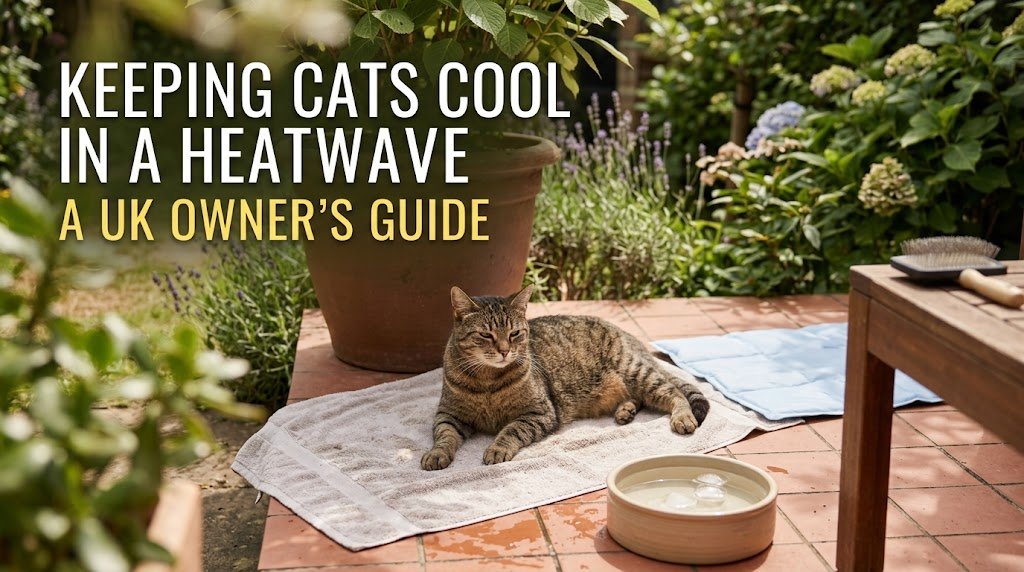
Why cats overheat more easily than you’d think
Cats didn’t get the memo that they live in a temperate island climate. Genetically, they’re descended from desert-dwelling ancestors, which is partly why they’re so good at conserving water and why they’ll happily nap in a sunbeam that would make you sweat just looking at it. That heat tolerance has limits, though, and once it’s exceeded, cats have far fewer ways of cooling themselves down than we do.
Humans sweat over most of their skin. Cats only have sweat glands in their paw pads, which barely makes a dent when the air temperature climbs into the high 20s or 30s. Their main cooling tools are grooming (spreading saliva over their fur so it evaporates and pulls heat away), finding cooler surfaces to lie on, and, as a last resort, panting — something healthy cats do so rarely that when you do see it, it usually means their body is already struggling.
Add a thick coat, dark fur that absorbs more heat, or a flat face that restricts airflow, and some cats are working with a much smaller safety margin than others.pin
Which cats are most at risk Keeping Cats Cool in a Heatwave
Every cat can overheat, but some need extra watching during a hot spell:
- Flat-faced (brachycephalic) breeds — Persians, Exotic Shorthairs, and similar breeds have shorter airways, which makes panting and heat regulation harder work
- Kittens under six months — their temperature regulation isn’t fully developed yet
- Senior cats, especially those over 11–12 years old
- Overweight cats — extra body fat acts as insulation, which is the last thing you want in the heat
- Cats with heart, lung, or thyroid conditions
- Long or thick-coated breeds like Maine Coons, Norwegian Forest Cats, and Persians
- Black or dark-coated cats, who absorb noticeably more heat from direct sun than pale-coated cats
If your cat falls into more than one of these groups, treat hot days as something to actively manage rather than something to just get through.
The early signs of heat stress in a cat
This is the part worth bookmarking, because catching it early is what keeps a hot afternoon from turning into an emergency vet visit.
Early signs to watch for:
- Restlessness or pacing, rather than the usual settled napping
- Stretching out flat on cool surfaces (tile, bathroom floors, laminate) more than usual
- Seeking out shade and refusing to move even when you call them
- Drinking noticeably more than normal
- Skin or fur that feels warm to the touch, particularly around the ears
Signs that things are becoming serious — treat these as urgent:
- Heavy, open-mouthed panting (again, this is not normal cat behaviour)
- Excessive drooling
- Bright red or very pale, dark gums
- Rapid heartbeat you can feel or see through the chest
- Wobbliness, disorientation, or bumping into things
- Vomiting
- Collapse or seizures
If you see anything in that second list, don’t wait to see if it passes. Move to the vet section below.
Practical ways to keep your cat cool
Get water right, not just available
One bowl in the corner of the kitchen isn’t enough during a heatwave. Cats are notoriously fussy about drinking, and dehydration sneaks up fast in hot weather. Put out two or three water sources around the house, refresh them at least twice a day so the water stays genuinely cool rather than lukewarm, and if your cat has never taken to a water fountain, this is a good week to try one — the movement encourages many cats to drink more than they would from a still bowl.
A couple of ice cubes dropped into the bowl also helps keep water cold for longer without diluting it much, and some cats enjoy batting them around before they melt.
Manage light and airflow, not just temperature
Most UK homes don’t have air conditioning, so the aim isn’t to make the house cold — it’s to stop it acting like a greenhouse. Close curtains or blinds on windows that get direct sun during the day, particularly south-facing rooms, and open them again once the sun has moved round. A fan placed so it circulates air around a room (not blasting directly onto your cat, which most cats dislike and will simply avoid) makes a real difference to how a room feels even without dropping the actual temperature much.
Give your cat access to the coolest room in the house — often a bathroom, hallway, or anywhere with tile or laminate flooring rather than carpet.
Groom out the extra insulation
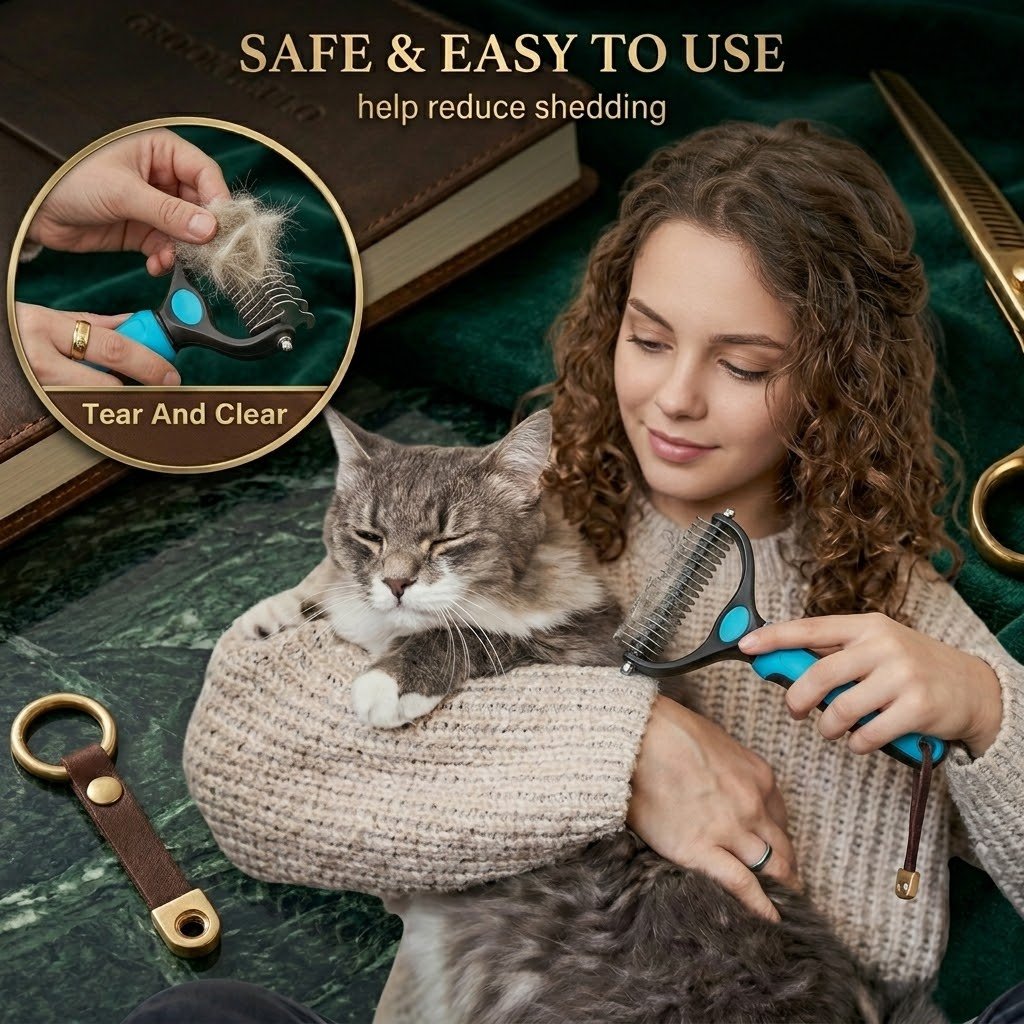
A cat carrying a full winter undercoat into a 30°C day is working against itself. Regular brushing removes loose, dead fur that would otherwise trap heat close to the skin, and it’s one of the few things you can actively do to help rather than just providing options and hoping your cat uses them. A grooming glove or de-shedding brush designed for cats makes this quick enough to do daily during a heatwave without it becoming a battle — five gentle minutes is usually enough to make a visible difference, and most cats tolerate a glove far better than a traditional brush since it feels more like being stroked. We’ve got a few grooming tools built for exactly this on the site.
One important exception: don’t shave a longhaired cat to “help” with the heat unless a vet has specifically recommended it for a health reason. Fur isn’t just insulation against cold — it also protects skin from sunburn and helps regulate temperature in both directions. Removing it can do more harm than good.
Give them something cool to lie on
A cooling mat (the gel or self-cooling type, not one that needs a freezer) is worth having down in a shaded part of the house during a heatwave. If you don’t have one, a damp towel laid over a cool tiled floor works as a decent stand-in, or a plain ceramic tile left in a shaded spot — many cats will choose it over their bed the moment the temperature climbs. It’s also worth thinking about where your cat’s normal bed sits; a bed positioned in direct afternoon sun is doing the opposite of what you want in July, so shifting it to a shadier corner for the summer costs nothing and helps more than people expect.
Frozen treats, in moderation
Freezing a small amount of wet food in an ice cube tray, or freezing the water from a tin of tuna (unsalted, in spring water rather than brine), gives your cat something to lick at that cools them down and keeps them entertained. Keep portions small — this is a treat, not a meal replacement, and too much too quickly can upset a sensitive stomach.
Timing matters more than most people realise
If your cat goes outside, try to keep them in during the hottest stretch of the day — roughly 11am to 3pm in a proper heatwave — and let them out earlier in the morning or later in the evening when the ground and air have cooled. Tarmac, decking, and paving can get hot enough to burn paw pads well before the air temperature feels unbearable to you. If you wouldn’t hold your palm flat against it for five seconds, it’s too hot for paws.
What to do about hosepipe restrictions
With hosepipe bans and water restrictions becoming a regular part of UK summers, filling a paddling pool for your cat (not that many cats would use one anyway) isn’t really an option in affected areas, and it’s worth knowing that most cooling methods for cats don’t need much water in the first place. A shallow tray with an inch of cool water, a damp flannel wiped gently over their fur, or water saved from a washing-up bowl for topping up drinking bowls all work perfectly well within typical restrictions. Cooling mats, shade, grooming, and good ventilation do most of the real work anyway — a hose was never the answer for cats the way it might be for cooling a garden.
Things that don’t help (and one that can actively hurt)
- Ice baths or cold water immersion — this can cause shock and is more likely to stress a cat than cool them safely. Cool, not cold, is the rule.
- Shaving your cat — covered above, but worth repeating: skip this unless a vet advises it.
- Leaving them in a conservatory, greenhouse, or car “just for a few minutes” — temperatures in enclosed glass spaces climb far faster than most people expect, even with a window cracked open.
- Forcing water or ice on a stressed cat — offer it, don’t insist. A distressed cat fighting you over an ice cube is more stressed, not less.
When it’s time to call the vet
Heatstroke in cats is a genuine emergency, and it can escalate quickly. If your cat is panting heavily, drooling excessively, seems wobbly or disorientated, has collapsed, or has vomited alongside any of the signs above, call your vet immediately — don’t wait to see if they improve on their own.
While you’re getting them to the vet or waiting for advice, move your cat to a cool, shaded, well-ventilated area, offer (don’t force) small amounts of cool water, and you can gently dampen their fur with cool — not ice-cold — water, focusing on the paws, ears, and belly, to help bring their temperature down gradually. Rapid cooling with very cold water can actually make things worse by causing blood vessels near the skin to constrict, so the aim is steady, not sudden.
A quick heatwave checklist
- Fresh water in two or three spots, refreshed daily
- Cool, shaded room with airflow, away from direct sun
- Regular brushing to remove excess fur
- Cooling mat or damp towel available
- Cat kept indoors during peak heat (roughly 11am–3pm)
- No paddling pools needed — a shallow tray or damp flannel does the job
- Know the early warning signs, and don’t wait if you see the serious ones
FAQs
What temperature is too hot for a cat? There’s no single cut-off, but most vets consider a room consistently above 32°C, combined with poor ventilation, a real risk factor for cats — particularly for kittens, seniors, overweight cats, and flat-faced breeds. It’s less about one number and more about how well your cat can escape the heat.
Do cats pant like dogs when they’re hot? Not normally, and that’s exactly why it matters. Panting is unusual for cats, so if you see it, treat it as a sign of genuine heat stress rather than a normal way of cooling down.
Should I bathe my cat to cool them down? A full bath is usually more stressful than helpful for most cats. A damp flannel wiped over the fur, focusing on the ears, paws, and belly, achieves a similar cooling effect with far less drama.
Can hosepipe bans affect how I keep my cat cool? Barely. Most effective cooling methods for cats — shade, airflow, grooming, cooling mats, small amounts of drinking water — use very little water and aren’t affected by typical UK hosepipe restrictions.
Is it safe to leave my cat home alone during a heatwave? Yes, as long as the home has shade, ventilation, and fresh water available in more than one spot. Close blinds on sun-facing windows before you leave, and avoid enclosed rooms with no airflow.
Keeping your cat’s coat in good condition is one of the easiest ways to help them handle a hot spell — browse our grooming tools to find one that suits your cat.